Multi-cloud strategies have taken a new step in the path of companies that want to be resilient, agile and have a competitive edge. With the growth of organizations in terms of digital footprint, using one cloud provider is no longer expected to fit the modern requirements of flexibility or risk management. A multi-cloud approach helps companies become more innovative, cost-effective, and business-resilient. Such strategies enable the organization to spread its workloads on two or more cloud providers without having a single point of failure and provide unique solutions to unique workloads. As hybrid work environments, real-time applications, and global customer bases continue to grow, multi-cloud architectures promise unprecedented scalability, performance, and reliability.
But as desirable as the benefits are, there are some difficulties in the implementation of multi-cloud strategies. Organizations should have a plan in place to move to a platform where there are no inconsistencies in terms of complexity and security. This paper discusses the multi-cloud environment, its benefits, possible challenges, and the most important factors that assist companies in achieving peak value.
Understanding the Multi-Cloud Landscape
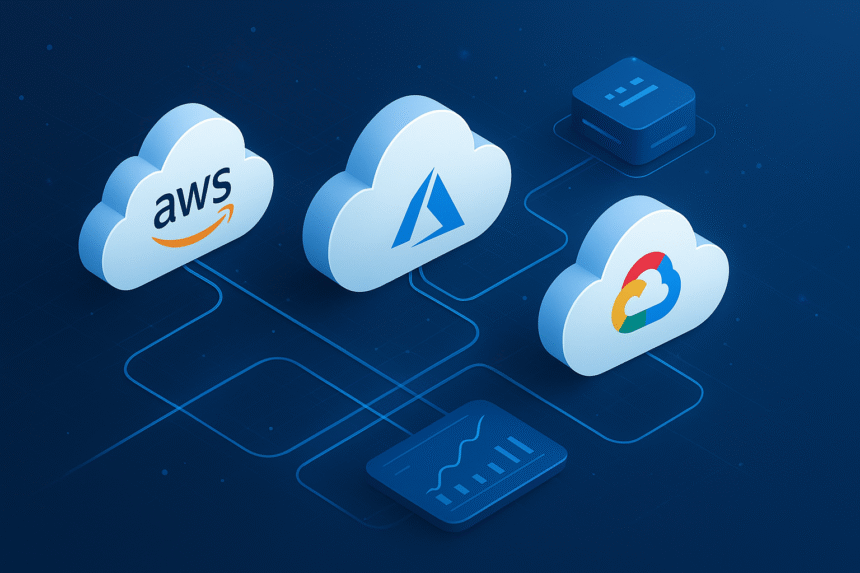
Multi-cloud refers to using multiple cloud service providers, such as AWS, Google Cloud, and Azure, simultaneously. Not relying on a single vendor to provide all the workloads, businesses spread computing, storage and application hosting on multiple cloud environments.
This approach prevents lock-in to a vendor, increases flexibility, and provides the ability for enterprises to choose the best-in-class solutions to a particular need. As an example, corporations can use AWS in machine learning loads, Azure in enterprise loads, and Google Cloud in analytics. This custom strategy enables companies to embrace the potential of every provider.
The benefits of Multi-Cloud Strategies
Multi-cloud strategies have a number of strong benefits for businesses. These are some of the key reasons that promote the adoption of enterprises.
Avoiding Vendor Lock-In
Vendor lock-in can restrict innovation, limit scalability, and increase long-term costs. A multi-cloud approach provides flexibility for organizations to migrate workloads when required, explore the options of new technologies, and not be tied to the pricing model of a single vendor or ecosystem.
Latency Optimization and Better Performance
Multi-cloud allows organizations to distribute services closer to the global users. Businesses can use the availability of various cloud providers across the globe to minimise latency, improve user experience, and expand quicker service delivery.
Business Continuity and Disaster Recovery
Sudden failure would have a devastating effect on income and customer confidence. Multi-cloud is also redundant; in case of failure of one provider, another may take over the operations. This spreads risk and enhances the recovery capabilities of a disaster.
Efficiency and Optimization of Cost
Multi-cloud strategies enable companies to select the most cost-efficient environment available to each workload. Various pricing models and discounts and capabilities are provided by different cloud providers. Companies can go a long way towards cutting down operational costs through the intelligent allocation of workload.
Best-of-Breed Solutions Innovation.
The cloud providers are good in certain aspects. AWS has a reputation for scalability, Google Cloud for AI-driven analytics, and Azure for enterprise services. Multi-cloud enables organizations to take the finest tools in different platforms to scale up innovation and productivity.
Scalability and Elasticity of Multi-Cloud Environment
The opportunity to scale effectively to various environments is one of the most effective benefits that multi-cloud strategies bring. Modern applications need scalability in order to handle changing loads, unpredictable user loads, and real-time data increases.
Elasticity guarantees that resources automatically scale according to the workload requirements. This is facilitated by multi-cloud environments, which have varying autoscaling capabilities, load-balancing solutions, worldwide distribution models, and container orchestration solutions such as Kubernetes.
The advantages of multi-cloud scaling are
More efficient distribution of resources.
Companies are able to assign tasks to the most suitable cloud platform. Compute-intensive tasks may go to one provider, while AI-heavy workloads may go to another.
Enhanced Global Reach
Multi-cloud provides more geographic availability zones. This supports faster content delivery, localised compliance, and low-latency performance for users worldwide.
Scaling Strategy Flexibility
Companies are able to use various scaling mechanisms instead of the limitations or pricing model of one provider to scale the workloads, enhancing performance and minimising bottlenecks.
High Availability Architecture.
Outages are minimized in distributed workloads. When one provider is offline, the autoscaling capabilities of another cloud can automatically be deployed, and operations proceed.
This elastic multi-layered architecture is the one that helps serve outgrowing applications, global teams, real-time analytics, and digital services, which need constant performance.
Managing Complexity: Multi-Cloud Strategies Challenges
Although multi-cloud strategies can be an incredibly valuable asset, they also cause certain difficulties that have to be overcome by organizations.
1. Higher Operational complexity
The multi-platform management implies various dashboards, tools, APIs and service configurations. There are no centralized control or orchestration tools, and day-to-day activities may become ominous.
2. Security and Compliance Issues.
Every cloud provider contains distinct security controls. It is difficult, but it is essential to make sure that the security policies, encryption standards, access management, and compliance are consistent in all platforms.
3. Interoperability and Integration Problems.
Information and applications should be transferred freely across clouds. When integration is poor, performance may be affected, data may be in silos, or communication may fail.
4. Cost Management and Monitoring
Multi-cloud can lead to cost savings, but it can only be effective when it is properly managed. It is not easy to monitor the use of resources among providers without the integration of tools. Unexpected expenses can be brought about by misconfigurations or idle resources.
5. Skills shortage and resource needs.
The teams need to know various cloud platforms. Finding or educating employees with the knowledge of multi-clouds is also vital, yet may be challenging because of the lack of talent in the field of cloud engineering and security.
Automation and cloud orchestration platforms, containerization, centralized dashboards, and cloud governance frameworks have been found to help organizations overcome these challenges.
Top Essentials to a Successful Multi-Cloud Strategy
To the companies intending to either deploy or enhance the multi-cloud strategy, the considerations should include:
1. Clear Business Objectives
Establish the reason why your organization requires multi-cloud cost savings, performance, flexibility, or innovation. This will make sure that your architecture choices are not made without purpose.
2. Workload and Application Evaluation.
Examine the workloads that can work with which cloud setup. They could be performance requirements, sensitivity of data, cost-effectiveness, and integration requirements.
3. Strong Governance Architecture.
Introduce security, compliance, resource utilization, and access control policies generalized to all cloud environments.
4. Security-First Approach
Enlist single security tools, encryption standards, and zero-trust architecture, as well as identity control among providers, to enforce a high level of security.
5. Single monitoring and automation tools.
Such tools as Kubernetes, Terraform, Prometheus, or cloud management tools may make operations simpler and less complex.
6. Budget Optimisation and Cost Controls.
Use cost visibility software, workload optimization, and automation to avoid excess spending.
7. Vendor Evaluation and SLAs
Learn about service-level agreements, performance guarantees, data policies and compatibility prior to choosing cloud providers.
With these factors in mind, organisations will be able to create robust multi-cloud architectures that will sustain growth and innovation in the long term.
FAQs
What is a multi-cloud strategy?
Multi-cloud strategy uses two or more cloud service providers to run workloads and improve flexibility, performance, and resilience.
Why do companies use multiple cloud providers?
Companies embrace multi-cloud to avoid vendor lock-in, improve performance, strengthen disaster recovery, and choose the best tools offered by different providers.
What are the key problems of multi-cloud?
Complexity, integration issues, inconsistent security policies, and the inability to manage platform-related costs are the largest challenges.
What is the difference between multi-cloud and hybrid cloud?
Multi-cloud involves multiple public cloud providers, whereas hybrid cloud involves a mixture of both private infrastructure and any of the public clouds.
How can businesses manage multi-cloud complexity?
Using centralized monitoring tools, automation platforms, DevOps practices, and strong governance policies can simplify multi-cloud operations.
Conclusion
Multi-cloud strategies provide organisations with the much-needed flexibility, performance and resilience to succeed in the current fast-changing digital ecosystem. The assignment of workloads among several providers enables businesses to improve their agility and limit their reliance on a single supplier and access best-in-class cloud capacity.