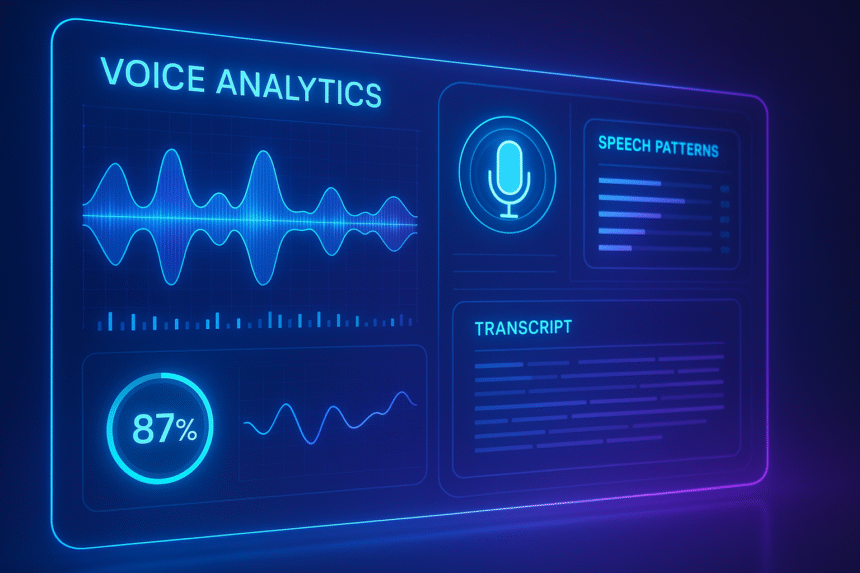
customer expectations are to be the greatest since they will require quick responses, personalization, and support in all channels. With the ongoing competition by businesses to attain these expectations, voice analytics has come out of the list of nice-to-have to essential technologies. Within the first 200 words of this article, it becomes clear why every customer-facing app, from support platforms to shopping apps to digital banking, needs a voice analytics layer to stay competitive.
Voice data isn’t just audio. It is feeling, purpose, scratch and grind, emotion and circumstance that can not be caught by text-only analytics. With increasing interactions moving to voice-enabled mediums, businesses are finding out that post-call and real-time analytics provide a source of strategic value that would have a direct influence on satisfaction, retention, and revenue
What Makes Post-Call Analytics a Strategic Advantage for Businesses
Voice analytics has quickly evolved into a foundational pillar of CX strategy. In particular, post-call analytics would enable companies to process raw conversations into actionable insights on a large scale.
Below are the factors that make post-call analytics indispensable in 2025.
1. Getting a Better Idea of Customer Intent
Greater knowledge than customary words
Search bars and chat logs will record what one is saying and not the manner of saying it. Post-call analytics recognizes the tone, urgency, hesitation and sentiment changes in a conversation.
Reduced misunderstandings
The voice communication may be misinterpreted, resulting in undesired support results. Analytics will highlight the unfocused explanations or points that the teams can rectify to close the training gap.
2. Comprehensive Sentiment and Emotion Tracking
Emotion-aware service upgrades
Sentiment analysis identifies frustration, confusion, excitement, or satisfaction. This assists in directing subsequent calls and also in making follow-ups feel more human.
Proactive retention
Businesses can also detect churn data, such as an increasing level of frustration or the number of repeat complaints, before customers make a decision to quit.
3. Trend Recognition in Thousands of Calls
Identifying recurrent problems
Post-call analytics indicates keywords, topics, and clusters of complaints that continue to emerge, enabling product teams to make decisions based on data.
Faster product iterations
Companies can see what customers like, dislike, or want the next day rather than months after the process of feedback.
4. Improved Agent Performance and Coaching
Data-backed feedback
Recordings of calls, however, form a treasure trove of training. Voice analytics records the winning strategies and also detects areas that the agents are weak.
Consistency at scale
Companies are dependent not on opinions, but on facts.
5. Automation of Regulatory & Quality Compliance
Observation necessitated expressions
Post-call detects the use of required disclaimers or compliance statements by the agents.
Risk reduction
Real-time notifications allow teams to resolve compliance loopholes before they turn out to be expensive.
6. Better Customer Journey Mapping
Multichannel integration
Post-call analytics connects voice interactions with chat logs, tickets, emails, and app usage patterns to form a complete customer journey.
Holistic personalization
Customers feel recognized—not just served.
The Question of how to integrate post-Call analytics in Customer-facing platforms
The integration of a voice analytics layer can be considered hard work, but 2025 technologies have simplified it significantly. It does not need huge engineering departments or costly systems any longer. Indeed, most APIs and AI services in the modern world have plug-and-play integrations with the existing apps.
The following is a practical guide.
1. Select an engine for voice analytics
Accuracy of transcription using AI
Use engines that are driven by large-scale speech-to-text models that can comprehend accents, industry-specific jargon, and multilingual interactions.
Detection of emotion and sentiment
Make sure that the engine can detect such emotions as anger, hesitation, or satisfaction; these insights can lead to actual change.
2. Assure API-Level Interconnection
Flexible architecture
Regardless of whether you have a microservice or a monolithic application, select analytics APIs that do not require significant code modifications to integrate.
Cloud vs on-prem options
On-premises analytics is more suitable in industries that are highly compliance-oriented, whereas cloud-based solutions scale more rapidly.
3. Connect Call Data Sources
Telephone suppliers’ importation
Your system must retrieve the recordings of calls with such providers as Twilio, Zoom, or internal VoIP systems.
Support multi-channel audio
This contains in-application calls and IVR records, as well as live agent discussions.
4. Automated Tagging and Categorization.
Topic classification
Automatically classify calls as a billing issue, technical support, refund request, etc.
The agent performance indicators.
Measures such as talk-to-listen, patience detection, and escalation triggers.
5. Seeing Insights with an Easy-to-use Dashboard
Real-time dashboards
Visually rich analytics dashboards are useful in customer-facing applications, particularly support applications.
Role-based insights
Product teams, different managers, and agents should have different views that are customized to their requirements.
6. Combine Automated Workflows and Alerts
Escalation triggers
The app must notify the supervisors when the sentiment goes down or when the terms that are considered risky are identified.
Workflow automations
Trigger tasks: Schedule follow-up, Send survey or open support ticket.
7. Make Security and Compliance a Priority
End-to-end encryption
Particularly relevant to healthcare, financial applications, insurance, and government applications.
PII redaction
Sensitive data are automatically removed to make use of recorded calls safer.
How Voice-Driven Insights Can Drive Growth and Loyalty
Voice analytics does not simply enhance after-call processes; it transforms product development, marketing, customer retention, and experience design in general.
That is the way businesses in the year 2025 are exploiting voice data to achieve incredible competitive advantages.
1. Increased Individualization on a Large Scale
Learning the tone of the customer preferences
The voice patterns demonstrate urgency, confidence, and emotional triggers. This enables the apps to make recommendations, propositions and customer support tailored to the actual requirements of the user.
2. More Effective Customer Retention Strategies
Detecting early churn indicators
Frustrated tone? Repeated complaints? Loss of patience?
Voice analytics helps businesses intervene before users leave.
3. Higher Conversion Rates
Call analytics in sales calls
The response rate of customers to offers helps sales staff to adjust the message.
Optimized scripts
Scripts that are supported by data seal deals quickly.
4. Product and UX Improvements
Voice data as feedback
Product teams are informed by conversations between users in the natural form, as opposed to polls.
Prioritized roadmaps
Priority issues are more likely to be discovered and acted upon.
5. High-Quality Customer Service
Faster resolutions
Analytics provides better context to agents, which reduces repeat calls.
Reduced frustration
Emotion detection makes sure that the appropriate agent is dealing with the appropriate customer at the appropriate time.
6. Stronger Brand Loyalty
Human-centered service
By listening to the customers literally, they will have the confidence to believe in the brand in the long run.
FAQs
1.What is a voice analytics layer?
The voice analytics layer is a technology that understands, interprets and transcribes a call made by a customer to reveal insights, like sentiment, intent, emotion, and trends.
2. Why will customer-facing apps require voice analytics?
The voice is on the rise. Voice analytics improves the quality of services, churn rates, and personalization of experiences to help apps gain a better understanding of their customers.
3. What is the process of post-call analytics?
Post-call analytics is AI-driven processing of recordings, sentiment detection, topic classification and insight that enhances support, training and product decisions.
4. Is voice analytics usable by small businesses?
Yes. Through the current cloud-based APIs, a business of any scale can incorporate low-cost voice analytics without involving complicated infrastructure.
5. Does voice analytics support sensitive industries?
Yes, provided the solution has the following components: strong encryption, access controls, and PII redaction to achieve compliance requirements in healthcare, finance, and insurance.
Conclusion
Voice is already an official element of the customer experience. Voice interactions cannot be predicted by text-only analytics, as they can contain emotional, contextual and behavioral cues not visible in text exchanges. Adding a voice analytics bot to your customer-facing application, you open the door to a strong personalization, support optimization, retention, and growth eng